The Braid and The Spine: How Diaspora Culture Travels
What does it mean to belong to a culture you were never fully inside? One of the world's oldest diasporas has been working on this problem for a century. The answer looks like a braid.
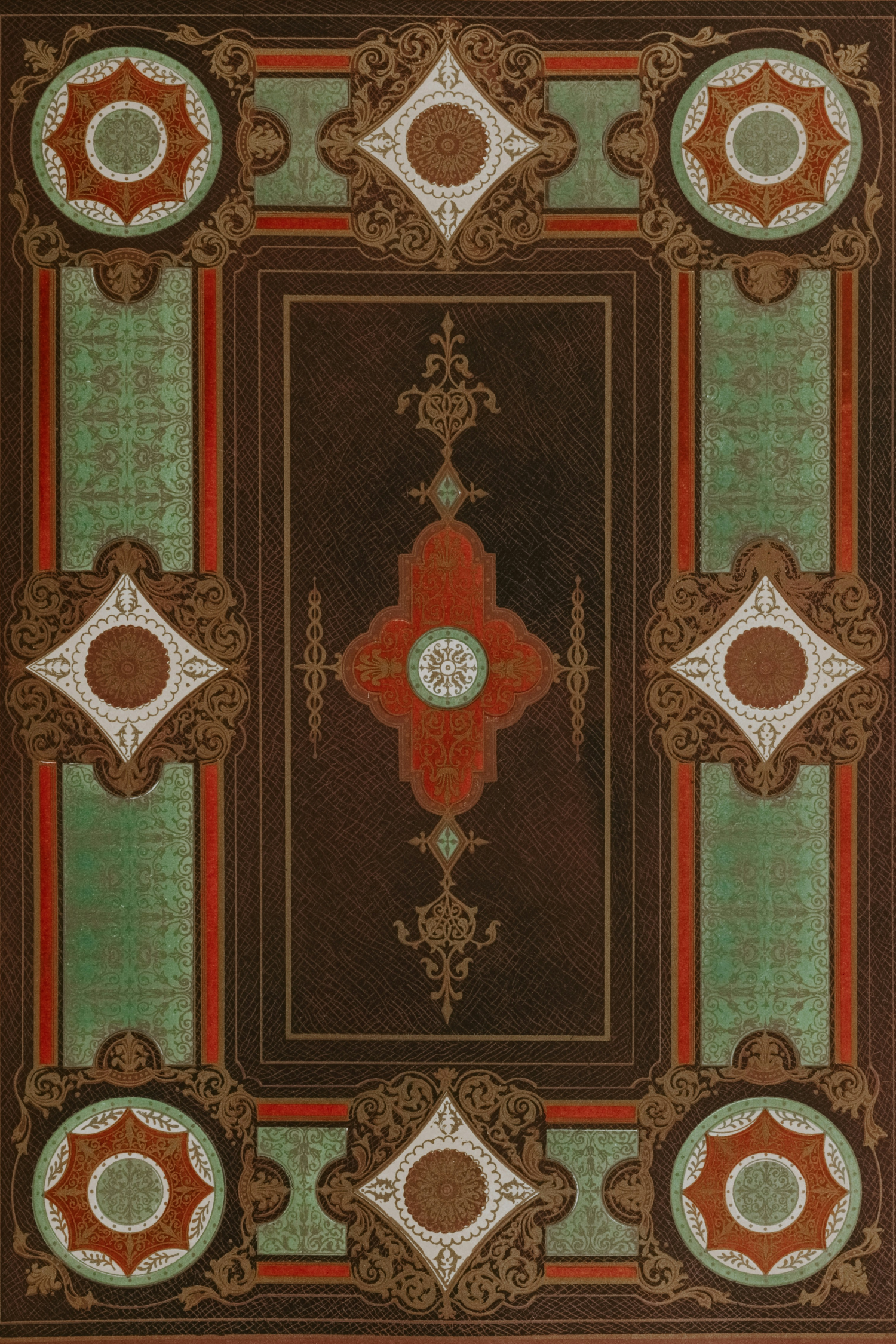
Photo by The New York Public Library on Unsplash
Join upcoming events.
〰️
Dream new patterns with kindred spirits!
Join upcoming events. 〰️ Dream new patterns with kindred spirits!
I arrived in the United States at fourteen with most of my forward energy pointed in one direction: absorb everything. American culture, North American references, the social codes of a new country, the cultures of everyone around me I needed to understand in order to become a citizen of this place. That process of integration required something I did not fully understand at the time — it required becoming a blank. You make space for the new by archiving the old. My Armenian and Russian roots went deep into storage. Not lost, just inaccessible, the way a language you stop speaking recedes below the surface.
That strategy has a cost that surfaces slowly. For me it arrived as burnout, as a loss of meaning, as the feeling of having built something that didn't quite belong to me. Going back down was the work — clearing what had crept in, reclaiming what actually belonged to the lineage. A lot of that happened obliquely, through other cultures and traditions, until I found my way back to my own. My Armenian lives in my ears more than my mouth — partial hearing, audio comprehension, the words understood but not yet fully spoken. I am learning Western Armenian now, finding my way into a version of the language my family didn't use. The entrance I am building for others is one I am still finding myself.
Folk Lounge began with my grandmother. An instruction that arrived, as these things sometimes do, from the other world: learn embroidery. The female lineage in this line demands it. You must learn from the elders and pass the information to the new generation. What I found when I followed it was not just a craft practice but an entire system: pattern as encoded knowledge, ornament as cosmological memory, the needle as the instrument through which a culture's understanding of the world passes from one body to another. The embroidery was the entry point. Armenian folk tradition was the room it opened into. Folk Lounge is that work made public. What I kept running into, building it, was the question this article is really about: what does belonging look like when the old definitions no longer fit?
Key Threads
Key questions this article explores:
What holds a culture together when there is no center to hold it?
Why does the oldest transmission technology in the world look like a braid?
When did a national identity become a fandom — and is that a bad thing?
What does belonging mean when the old password no longer works?
When The Homeland Is Outnumbered
Armenia has approximately three million people living inside its borders. The Armenian diaspora has somewhere between seven and ten million, spread across Russia, France, Lebanon, the United States, Argentina, Syria, and beyond — each community shaped by the specific history that brought them there, speaking different languages, holding different versions of what Armenian means. This is not a diaspora organized around the hope of return. It is a diaspora that has been outside longer than living memory, that has built permanent institutions, that has produced literature, music, and cultural practice in languages other than Armenian, and that continues to identify as Armenian across generations that have never seen the homeland. The question worth asking is not whether the culture survived displacement but how. What is the actual mechanism by which a culture without a center holds together and keeps moving?
Armenia is one of the oldest continuously inhabited civilizations on earth, the first nation to adopt Christianity as a state religion in 301 CE. Long before that, Armenians worshipped a pantheon of fire gods and dragon-slayers. Armenian folk literature predates the Armenian alphabet. The stories were older than the ability to write them down.
What the collectors understood — the bishop in disguise, the researchers in Detroit, Leon Surmelian at his desk in Los Angeles — is that folk tales are not decorative. They are a cosmological system, a way of understanding the relationship between human beings and the world they inhabit, carried in story form because story is the most portable and durable container there is. Robert Bedrosian's Armenian Folklore and Mythology Resources at Internet Archive is a 48-page clickable index of what those collectors left behind — the most practical single guide for anyone who wants to go deeper.
Sources:
“I have never known which was my first language, and have felt fully at home in neither, although I dream in both.”
The Braid
Armenian diaspora culture maintains a spine — the homeland, the language, the genocide as a founding rupture, the pre-Christian cosmological tradition, the specific texture of Armenian folk knowledge. That spine exerts pull even across four generations of displacement. What happens around it is braiding. New strands are added — French-Armenian hybrids, Lebanese-Armenian fusions, Russian-Armenian crossings, Los Angeles Armenian creations that exist nowhere else — and these strands braid back into the main spine, changing its texture, adding new material, sometimes pulling so far from the origin that they connect only by a single remaining thread. The braid maintains tension. There is always pull in both directions.
The braid is not a metaphor invented for this essay. Braids appear across cultures that had no contact with each other because the problem they solve is universal. A Lakota elder describes the three-strand braid as one for the higher power, one for the earth, one for the spirit. In Armenian tradition the act of braiding was itself the transmission — elders and children sitting together, stories exchanged in the making. Across cultures it encodes identity, cosmology, and lineage simultaneously. Historically it was women's work — hair, textile, lace, embroidery. But what that really names is a particular kind of attention: the slow, repeated, relational act of making that any hands can hold. In Armenian tradition that work was not decorative. It was the mechanism by which the culture survived.
When A Diaspora Becomes A Fandom
The canon exists but cannot control its derivatives. A fandom is a distributed community with no central authority, that generates its own hierarchies, produces enormous derivative work, and maintains fierce arguments about authenticity and who has the right to speak for the community. Armenian diaspora does every single one of these things. The arguments about who is authentically Armenian — whether diaspora Armenians count, whether Armenians who don't speak the language count, whether children of mixed marriages count — are canon debates.
The proliferation of Armenian cultural expression across dozens of languages is fan production. What makes the Armenian case particularly interesting is the ratio: more people live outside than inside. This is a national identity that has functionally become a participatory culture — generative, contested, and alive in exactly the ways that closed institutional structures are not.
How Do We Measure Belonging?
In the old model, belonging was measured by proximity to the spine. You speak Armenian, you live in Armenia, you marry Armenian, you belong. Lose any of those and your belonging is questioned. That model creates a hierarchy of authenticity the diaspora has been quietly destroying for a century without anyone naming a replacement.
My kids don't speak Armenian. I understand it but don't speak it fluently — my language is audio, not active. When there are Armenian cultural events, my kids sometimes don't go, not because they don't care, but because they can't enter. The old password — language fluency, cultural pre-knowledge, the ability to perform belonging correctly — is one they don't have. So they opt out even though they want in. That gap between caring and being able to cross the threshold is where the old model fails. And it is failing across an entire generation starting with mine.
The same gap appears at the collective scale. For my generation, belonging was tested viscerally during the wars over Nagorno-Karabakh — my father's region, the place his family came from — watching from Los Angeles as the homeland was contested and then lost, with nothing to do but signal into the network. The helplessness of diaspora during a homeland crisis is specific: you care completely, you can act only minimally. Caring turns out not to be enough in the old model. You have to also be there, also speak, also act. And when you can't, the gap between belonging and being able to demonstrate it becomes impossible to ignore.
Stuart Hall called this the difference between roots and routes — where you come from versus the path you have traveled. My kids' route includes visiting their grandfather in Yerevan, hanging out with family, having their favorite food and drinks, and eventually as they get older, mapping the quirks in me back to my culture — family habits, unspoken household items, a small brass coffee pot sitting there as it always has. That route is theirs. It connects to the roots without being identical to them. There is a difference between wanting to go back to where you came from and simply wanting to feel at home in who you are. Most diaspora theory focuses on the first. What my kids are building is the second — and it turns out to be enough.
This is the new measure the braid model proposes: belonging is not proximity to the spine but the quality of the connection between your strand and the spine. A strand that has traveled far, incorporated other materials, and still maintains a thread back to the spine is not less Armenian. It is the braid doing exactly what braids do. Folk Lounge is built on this premise — making, pattern, story, cosmological thinking as entry points that don't require a password. The braid accepts the new strand regardless of where it came from. The connection is made in the act of making.
Sources
Stuart Hall — Cultural Identity and Diaspora (1990), in Identity: Community, Culture, Difference, ed. Jonathan Rutherford
Avtar Brah — Cartographies of Diaspora: Contesting Identities (1996)
Woven Wisdom
Truth worth holding onto:
The Blank Has A Cost Integration into a new culture requires space, and making space often means archiving what you came from. The cost surfaces slowly — as burnout, as disconnection, as the feeling of having built something that doesn't quite belong to you. Going back is not regression. It is the necessary work.
Belonging Is A Practice, Not A Credential The old measures of belonging — language, lineage, geography — exclude people who care and include people who don't. Belonging here is not a credential. It is a practice — something you demonstrate through engagement, not inheritance.
New Strands Strengthen The Braid Cultural hybridity is not dilution. The French-Armenian, the Lebanese-Armenian, the Los Angeles Armenian — these are not lesser versions of the culture. They are new strands braided into a spine strong enough to hold them. The braid gets richer with every addition. The pattern changes. It does not disappear.
Practice Toolkit
Map Your Own Braid Take a piece of paper and draw your cultural strands — not just ethnicity but everything that has shaped how you understand the world. Languages, traditions, places, practices, people. Notice which strands connect back to a spine and which ones are still loose. Notice where the braiding happened and where it hasn't yet. This is a map of your actual inheritance, not an exercise in identity politics.
Find The Strand You Archived Think about what you set aside to survive a transition — a move, an integration, a period of intense change. What went into storage? It does not have to be cultural in the national sense. It can be a practice, a way of thinking, a relationship to making. Name it. Consider whether it is time to bring it back into the braid.
Make Something That Adds A Strand Make something that could only have come from the specific crossing of traditions that is your life. That crossing is not incidental. It is the work.
The question I keep returning to, building Folk Lounge, is not how to preserve culture but how to keep the threshold open — how to build entry points that don't require the old password, that let the people who care find their way to the strand that connects them. The braid accepts the new strand regardless of where it came from. The connection is made in the act of making. There is still not enough belonging in the world — we are still fighting for the sun even in our own cultures, subcultures, and communities. That is exactly why the door has to stay open.
Events
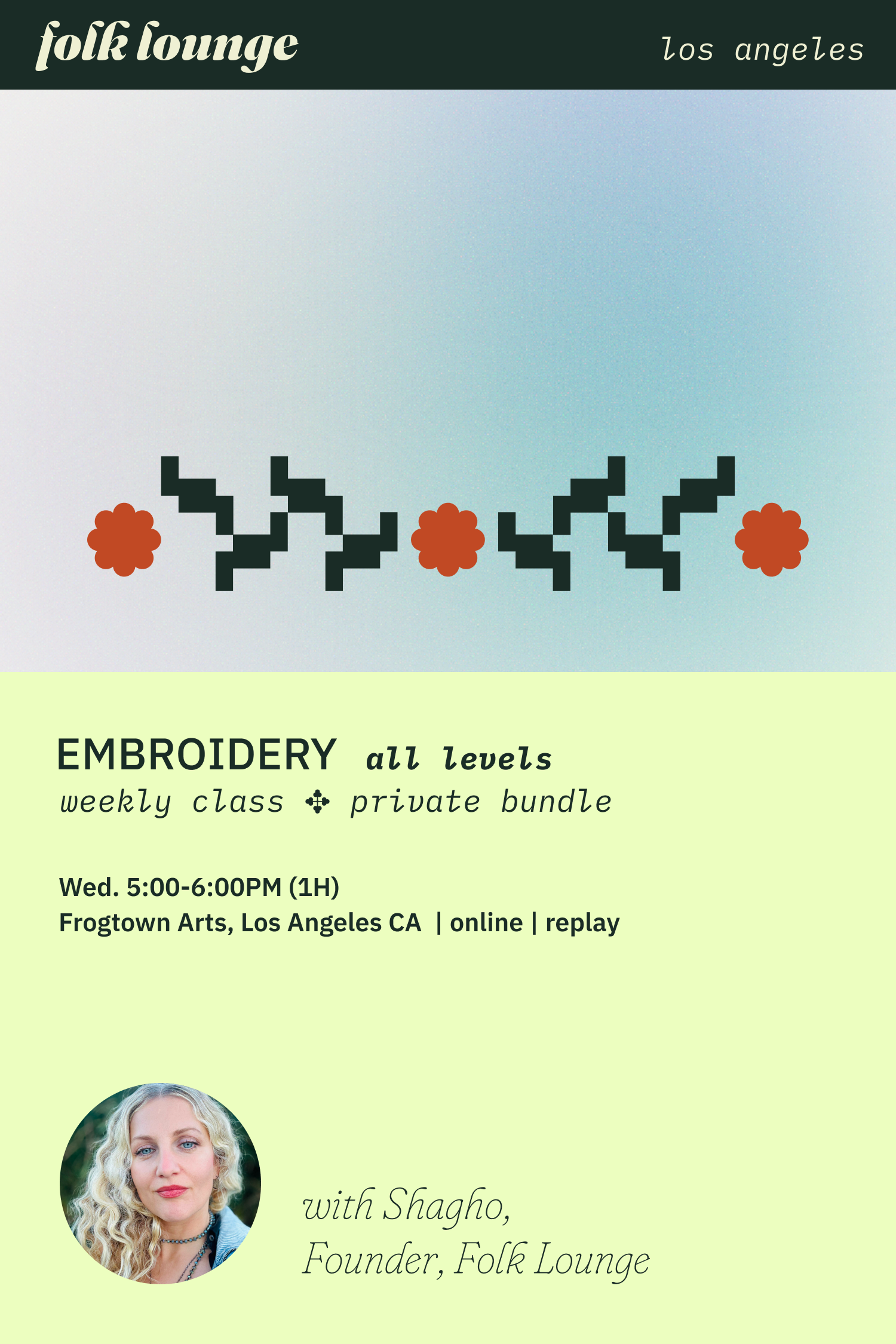
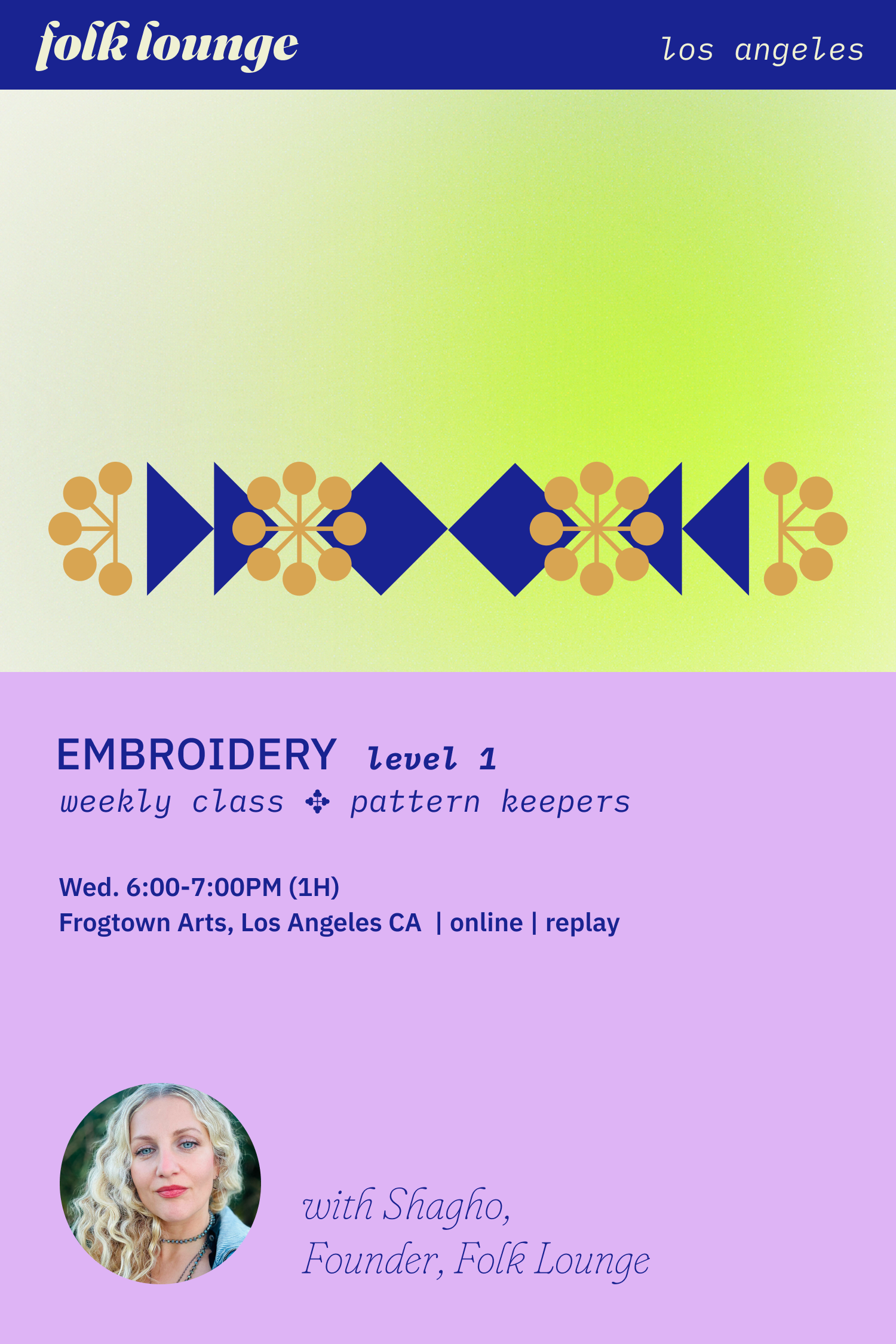
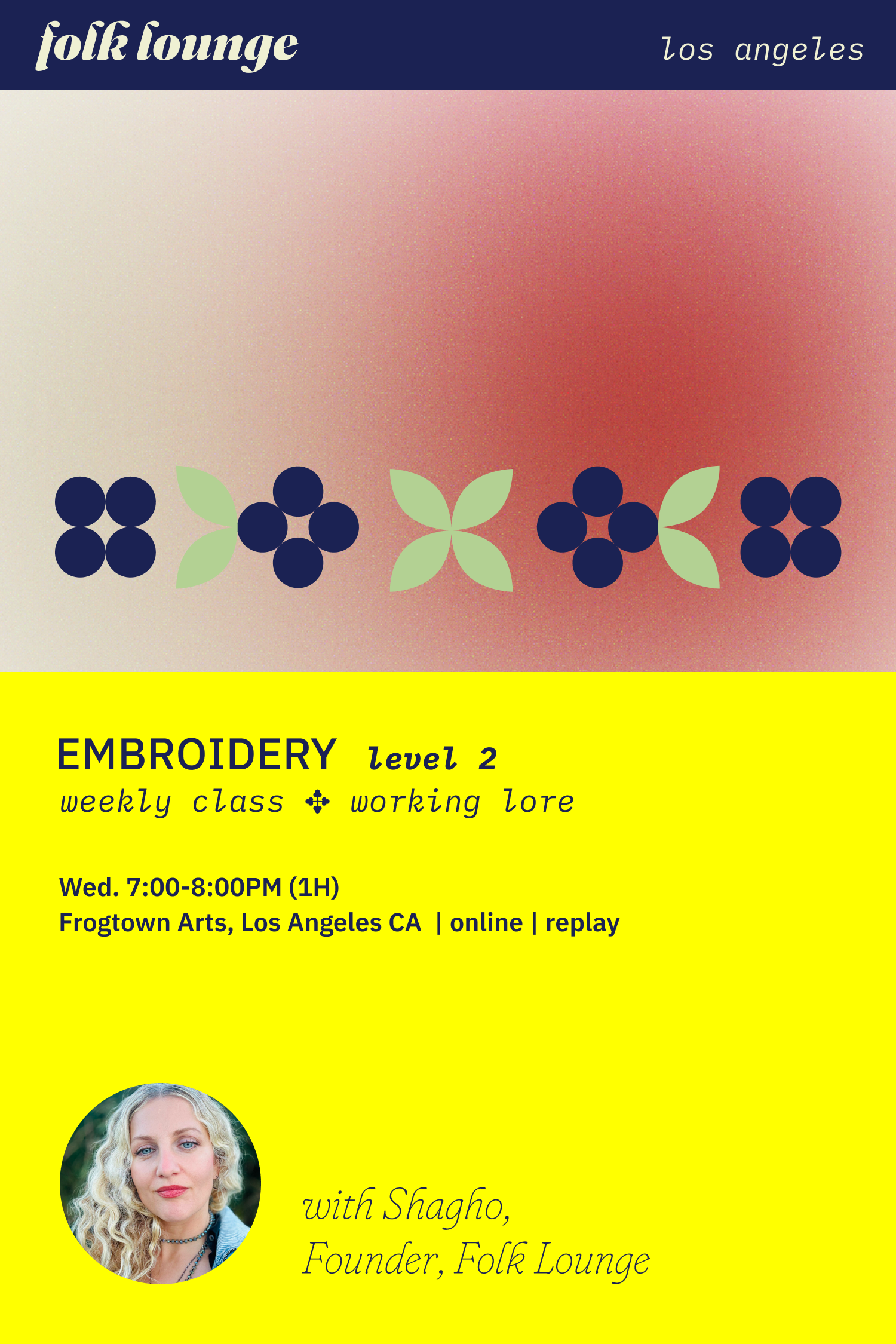
Ready to dive deeper? Join our community of master artisans, cultural stewards, and creative practitioners exploring the intersection of traditional craft and contemporary life. Classes, intensives, and ceremonial gatherings across LA and online for artists, designers, crafters, illustrators, and makers of all backgrounds and levels. Our programs unite ancient wisdom with contemporary practice, cultivating living heritage through embodied craft, storytelling through making, communion with nature, cultural preservation, meditative practice, and the celebration of life's luminous beauty.
#diaspora #belonging #culturalidentity #braidedculture #culturaltransmission #hybrididentity #rootsandroutes #armeniandiaspora #armenia #yerevan #thirdculture #diasporiccreatives #belongingmatters #immigrantexperience #multilinguallife #culturalrecovery #folklounge #patternkeepers #participatoryculture #heritagemaking