Talk For The Craft Contemporary: Narrative Embroidery & Hero’s Journey Scroll
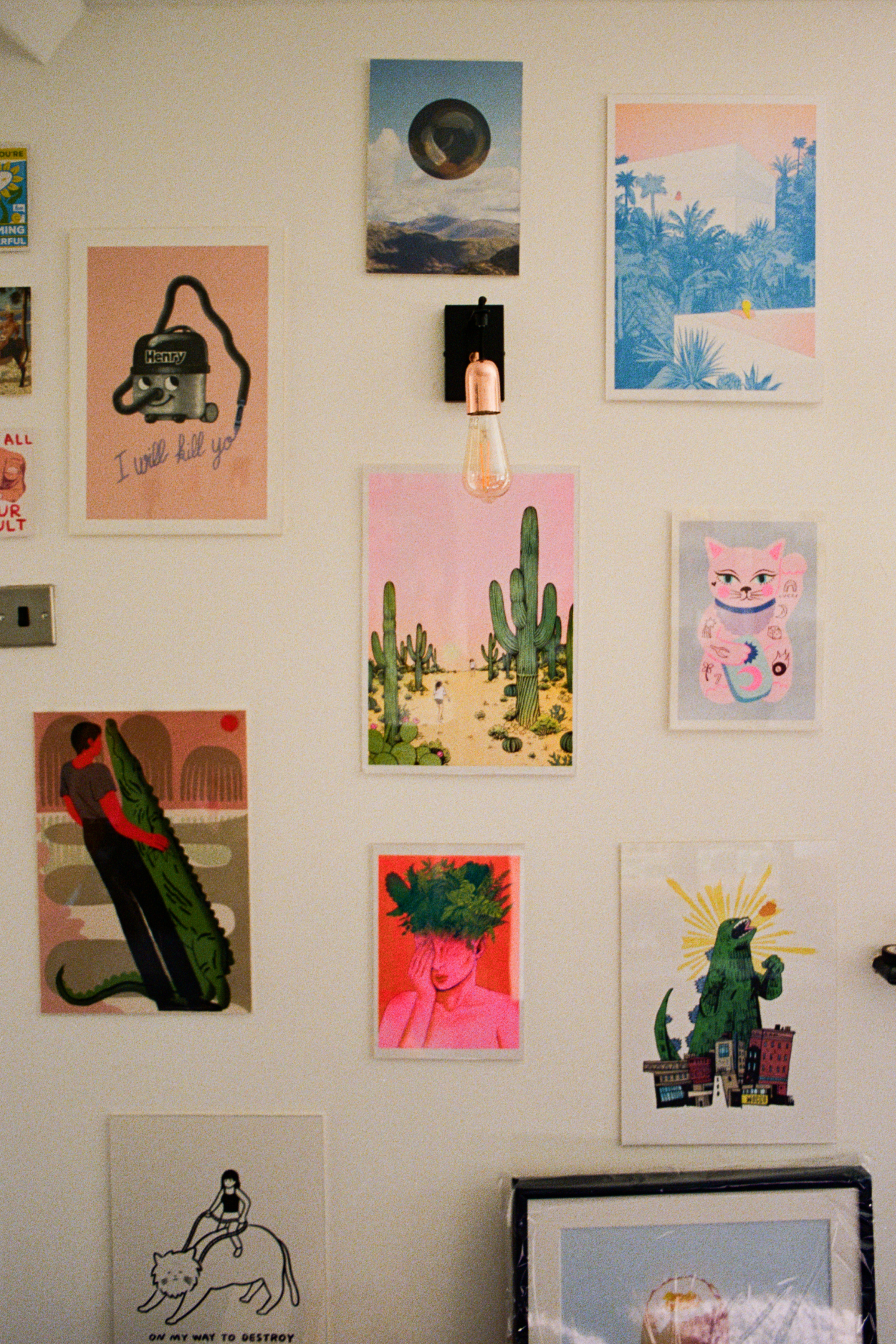
What does it mean to archive a life? The Epic of Gilgamesh, one of humanity's oldest stories, was pressed into clay tablets over four thousand years ago by hands that understood something we are still learning: that what we do not preserve disappears.
Photo by Annie Spratt on Unsplash
Join upcoming events on Eventbrite
〰️
Join upcoming events on Eventbrite 〰️
When Carrie Burckle reached out about teaching a class at Craft Contemporary, I found myself drawn immediately to narrative embroidery — a form that is fluid, illustrative, and playful in ways that traditional counted-stitch work often isn't. It felt like exactly the right medium for the kind of story-preservation work I'd been thinking about: personal, embodied, and unhurried. Through this workshop, participants explore embroidery not as decoration but as documentation — becoming the archivist of their own magic, stitching lineage, labor, and lived experience into tangible, enduring form. This workshop begins with that ancient urgency and turns it personal. What are the unspoken stories, quiet triumphs, and forgotten transformations that have shaped you — and what would it mean to stitch them into lasting form?
Key Threads
Key questions this article explores:
How does the Epic of Gilgamesh connect the ancient impulse to preserve with our own need to record the chapters of a life?
What can the Hero's and Heroine's Journey frameworks teach us about recognizing the transitions we are living through right now — the endings, the in-between seasons, and what is quietly becoming?
How does the act of narrative embroidery bridge past and present — transforming personal memory and lived experience into symbolic, tangible form?
Why does making something slowly by hand, in community, feel like a fundamentally different kind of storytelling?
Marking Surfaces
Tablets
The clay tablet was invented by the Sumerians of ancient Mesopotamia (modern Iraq), making it the oldest confirmed writing medium. Using a cut reed stylus, scribes pressed wedge-shaped marks into soft clay — a script we now call cuneiform — before leaving tablets to dry in the sun for temporary records or firing them in a kiln for permanent storage. Contrary to romantic notions, most early tablets were profoundly mundane: writing was invented for accounting, not poetry. Tablets came in various sizes, from postage-stamp-sized receipts to large multi-tablet series, like the Epic of Gilgamesh, which spanned twelve tablets.
The cuneiform system spread far beyond Sumer, adopted and adapted by the Akkadians, Babylonians, Assyrians, Hittites, Elamites, and Persians. At its peak, cuneiform functioned as the international diplomatic script of the ancient Near East — used much the way English is used globally today. The greatest monument to this tradition is the Library of Ashurbanipal in Nineveh (c. 668–627 BCE), which housed over 30,000 clay tablets, including the most complete surviving version of the Epic of Gilgamesh, and stands as arguably the world's first systematically organized library. Cuneiform persisted for over 3,000 years before finally dying out around 100 CE — one of the longest-lived writing systems in human history.
Scrolls
While Mesopotamia was pressing words into clay, Egypt was rolling them up. Among humanity's oldest information technologies, the scroll dates back over 4,000 years, with ancient Egypt producing some of the earliest known examples. Made from papyrus — a reed harvested along the Nile — these scrolls carried some of antiquity's most significant texts, including the famous Book of the Dead.
Ancient Greece and Rome later standardized the scroll, known in Latin as the volumen, as the dominant book form across the Mediterranean world. Reading one was a two-handed affair — unrolling with one hand while re-rolling with the other — which is partly why the most dramatic passages were often placed at the beginning or end, where they were easiest to reach. Libraries of antiquity, including Alexandria, housed thousands of these rolls. China, meanwhile, developed its own independent scroll tradition using silk and later paper (invented around 105 CE), a format that persisted far longer there than in the West and deeply shaped East Asian book arts. By roughly the 1st to 5th centuries CE, the scroll was gradually displaced in Europe by the codex — the ancestor of the modern book — which was more compact, easier to navigate, and better suited to Christian liturgical use.
Epic Of Gilgamesh
Epic
The epic poem is arguably the oldest literary genre, predating writing itself. The oldest known epic is the Epic of Gilgamesh (PDF), composed in Sumerian around 2100 BCE and later expanded in Akkadian — a king's quest for immortality that also contains one of the earliest flood narratives in recorded history. It is the story that bridges clay and papyrus, tablet and scroll: first pressed into clay in Mesopotamia, its themes traveled across cultures and centuries, copied, translated, and retold on whatever surface the next civilization had at hand.
As Wikipedia's entry on epic poetry defines the genre: an epic is "a lengthy narrative poem typically about the extraordinary deeds of extraordinary characters who, in dealings with gods or other superhuman forces, gave shape to the mortal universe for their descendants." A full list of world epics can be found at Wikipedia: List of World Folk-Epics.
Gilgamesh
Gilgamesh, king of Uruk, is two-thirds god and one-third man — powerful, restless, and tyrannical. The gods create a wild man named Enkidu as his equal and counterweight. The two meet, fight, and become inseparable companions. Together they slay the monstrous Humbaba and the Bull of Heaven — and for their defiance, the gods decree that Enkidu must die.
Enkidu's death shatters Gilgamesh. Confronted for the first time with his own mortality, he abandons his kingdom and sets out across the ends of the earth in search of eternal life. He finds Utnapishtim — the one mortal granted immortality by the gods — who tells him the secret of a plant that restores youth. Gilgamesh retrieves it from the bottom of the sea, only to have it stolen by a serpent while he sleeps. He returns to Uruk with nothing, and stands before his city's great walls — the only immortality, the poem suggests, that any man can hope for.
The epic contains striking parallels to later religious texts, including a flood narrative — in which Utnapishtim survives a divine deluge by building a great boat and loading it with animals — that predates and closely resembles the story of Noah's Ark. It grapples with themes that feel startlingly modern: friendship, grief, the fear of death, the hunger for meaning, and the acceptance of human limits.
The most complete version was discovered among the 30,000 tablets of the Library of Ashurbanipal in Nineveh, excavated in the 1850s. The tablets had been buried for over 2,000 years. The epic was deciphered and published by British Museum scholar George Smith in 1872 — causing a sensation when the flood narrative became public.
Sources:
The Hero & The Heroine
The Hero's Journey (PDF), also called the monomyth is a narrative framework identified by mythologist Joseph Campbell in his 1949 book The Hero with a Thousand Faces. Campbell noticed that stories from vastly different cultures and eras share a remarkably similar underlying structure — a universal pattern of transformation. The journey is broadly divided into three phases:
1. Departure (The Ordinary World) The hero begins in a familiar, comfortable world. Something disrupts that comfort — a Call to Adventure. The hero often initially refuses this call out of fear or doubt, but eventually crosses a threshold into the unknown, often guided by a mentor figure.
2. Initiation (The Special World) This is the heart of the story. The hero faces a series of tests, allies, and enemies. They approach a central ordeal — the most dangerous moment — and are transformed by it. They seize a "reward" (knowledge, an object, inner strength) as a result.
3. Return (The Road Back) The hero must bring their transformation back home. The journey isn't complete until the gift is shared with the ordinary world. The hero returns changed, and the world around them is better for it.
The Heroine's Journey (PDF) is most associated with Maureen Murdock, who developed it in her 1990 book The Heroine's Journey — ironically, in direct response to Campbell. Murdock had actually studied with Campbell, and when she asked him about the feminine experience in myth, he reportedly said women don't need to make the journey because they are the destination. She disagreed, and wrote the framework herself.
The Hero's Journey is fundamentally about separation and conquest — leaving home, defeating something external, and returning transformed. It's a linear, outward arc driven by achievement.
The Heroine's Journey is about fragmentation and wholeness — it's a psychological and relational arc that moves inward, dealing with the split between the feminine and masculine aspects of the self, and ultimately integrating them.
Where the hero slays the dragon, the heroine typically has to reckon with what the dragon represents internally.
A Journey Of Many Transitions
First published in 1980, Making Sense of Life's Changes (PDF) by William Bridges was the first book to explore the underlying and universal pattern of transition
This is probably the most important and underappreciated idea in the book. Bridges first clarifies the distinction between change and transition, stating that our society confuses them constantly. Change is situational — a move to a new city, a shift to a new job, the birth of a baby, or the death of a loved one. Transition, on the other hand, is psychological. It is the personal side of change; the inner reorientation and self-definition that a person has to go through in order to incorporate any of those changes into their life.
In other words, change is an event. Transition is a process. You can change in an instant — a diagnosis, a divorce, a job loss — but the transition that follows can take years. Society often rushes people through change while ignoring transition entirely, which is why so many people feel stuck or lost even after the external circumstances have resolved.
Bridges takes readers step by step through the three stages of any transition: The Ending, The Neutral Zone, and, eventually, The New Beginning.
1. The Ending: Counterintuitively, every transition begins here — not with a new beginning. Every transition begins with one. Too often we misunderstand them, confuse them with finality — that's it, all over, finished! Yet the way we think about endings is key to how we can begin anew. Bridges identifies five aspects of the ending experience: disengagement, dismantling, disidentification, disenchantment, and disorientation. The key task is letting go of the old identity or situation, which most people resist or rush through.
2. The Neutral Zone: This is the heart of the book and its most original contribution. In this seemingly unproductive time-out, we feel disconnected from the past and emotionally unconnected to the present. The most frightening stage of transition, the Neutral Zone is really an important time for reorientation. Bridges draws on mythic traditions — including the wilderness, the desert, the underworld — to frame this liminal space not as failure or stagnation, but as a necessary incubation period where the old self dissolves and the new self begins to form. Modern culture, obsessed with productivity, tends to pathologize this stage. Bridges rehabilitates it.
3. The New Beginning: Sometimes the beginning results from careful and conscious effort, but for most people important new beginnings have a mysterious and sometimes accidental quality to them. That spark may be an idea, an impression, an activity, an experience, or a feeling. Crucially, Bridges argues that beginnings cannot be forced — they can only be prepared for, and recognized when they arrive.
“Tell me, what is it you plan to do with your one wild and precious life?”
Pinterest: Narrative Embroidery
Ice Breaker
What was the most meaningful transition of your life when you look back?
Inspiration
Project Steps
Take a your cotton scroll and remove threads and fuzzies, leaving a little fringe.
Work on the front, allowing the back to be messy (noone will see it).
You will have a base for about 8 chapters, you can always extend it with more fabric.
Use clear tape to draft or sketch the order of chapters, ideas and symbols.
Lean on doodle illustration sets, Chika Miyata’s & Yooco Takashima’s book for inspo.
Map the order of backgrounds you want to use & any patchwork you want to make.
Spread out the embellishments: ribbons, charms, beads or threads.
Stay in the flow with one thread color, Maidera Fluorescent Pink or Tree Fog Green.
Don’t spend more than 10m sketching, a lot will have to be simplified and abstracted.
An easy place to start is writing down your city and birth date with a self portrait, capturing something floral decorative to capture your arrival and something from the mood of your home land.
Work on one panel at a time, it is ok if you need more than one panel for your period. There is no right or wrong way to journal your experience and milestones. It does not need to be logical, uniform or perfect. It can be dreamy, incomplete and abstract.
Use the zig zag ribbon to make tassel to tie your scroll in the end.
Stitch Menu
Woven Wisdom
Truth worth holding onto:
The Archive Is Personal: Every life contains chapters worth preserving — not just the dramatic ones. The unspoken, the quietly survived, and the slowly transformed are often the most important threads to save.
Making Is Remembering: Stitching slows time enough for memory to surface. Narrative embroidery doesn't just record a story — it creates the conditions for that story to be truly felt and understood.
The Scroll As Witness: What we make with our hands outlasts us. Your scroll is conservation work — ensuring that what you have lived, survived, and become does not disappear.
Cultural Memory Toolkit
Story Mapping: Before you stitch, draw your journey. Sketch the moments of ending, the in-between seasons, and the new beginnings that have shaped who you are today. Don't edit — let the map be honest.
The Gilgamesh Question: Ask yourself what Gilgamesh ultimately asked: What do I want to leave behind? Let that question guide what you choose to preserve on your scroll.
Locate Yourself: Using Bridges' three stages as a guide, ask honestly — am I in an Ending, a Neutral Zone, or a New Beginning right now? Knowing where you are changes what you need to make.
Gilgamesh spent the whole epic trying not to die — and what he lost along the way was the actual texture of being alive. We understand him. But Bridges teaches us something that complicates the romance of immortality: every New Beginning requires an Ending first. To freeze is to stop becoming. And somewhere beneath our longing for permanence lives an equally powerful longing for its opposite — for transformation, for the relief of finally letting something go.
The scroll lives inside that paradox. It is not an act of freezing yourself — it is an act of setting a version of yourself down gently enough that you can walk forward without carrying it. You stitch a chapter closed not to be immortal, but to be free. Not to stop the journey, but to mark where you've been and make some space for what is still becoming.
Events
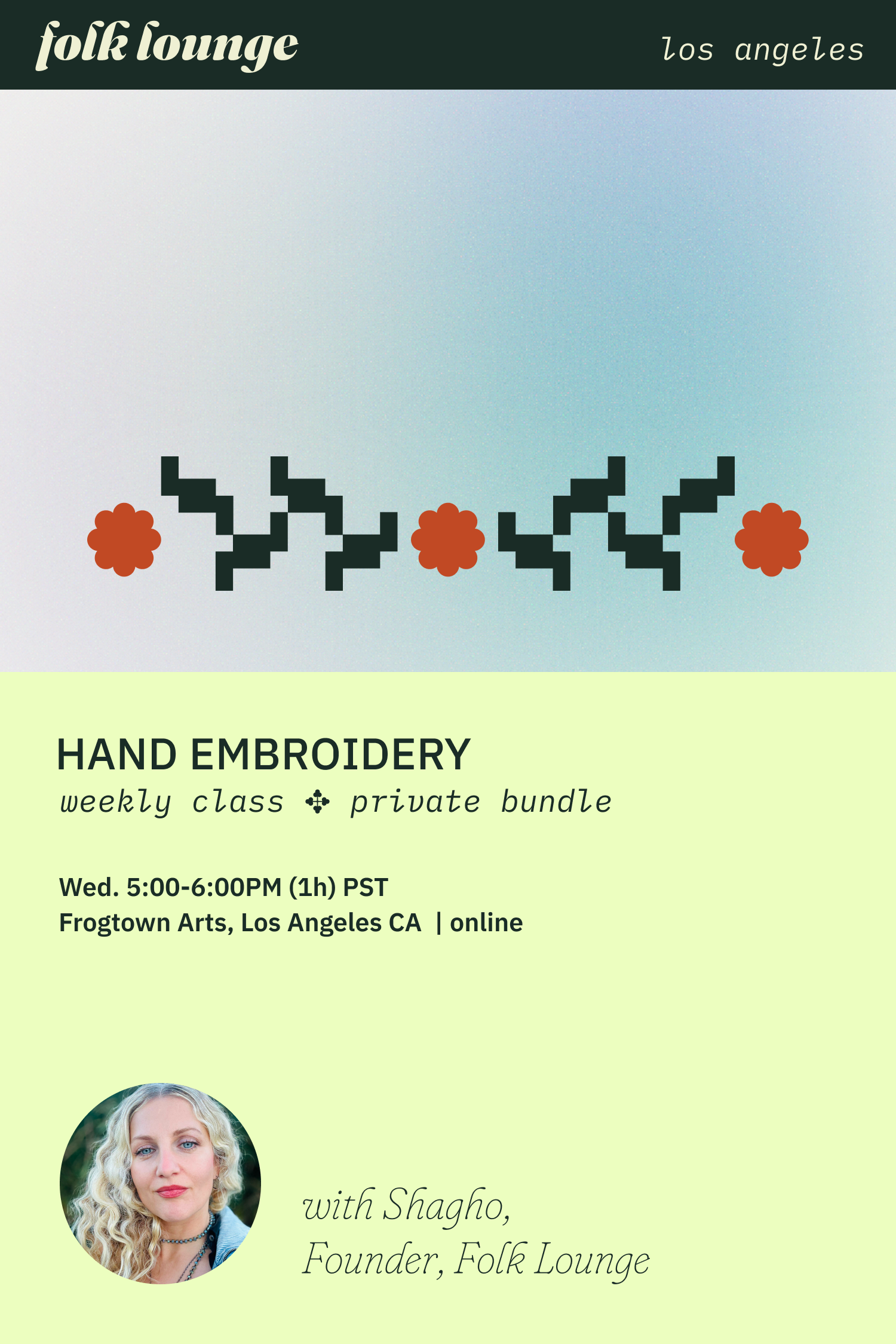
Ready to dive deeper? Join our community of master artisans, cultural stewards, and creative practitioners exploring the intersection of traditional craft and contemporary life. Classes, intensives, and ceremonial gatherings across LA and online for artists, designers, crafters, illustrators, and makers of all backgrounds and levels. Our programs unite ancient wisdom with contemporary practice, cultivating living heritage through embodied craft, storytelling through making, communion with nature, cultural preservation, meditative practice, and the celebration of life's luminous beauty.



#narrativeembroidery #herosjourney #epicofgilgamesh #josephcampbell #monomyth #williambridges #transitions #lifechapters #craftcontemporary #folklounge #embroideryworkshop #heroinesjourney #cuneiform #ancientstorytelling #personalmythology #textileart #scrollmaking #storytellingthroughcraft #liminalspace #lifetransitions