Notes on Pattern, Physics, and Aesthetic Mathematics
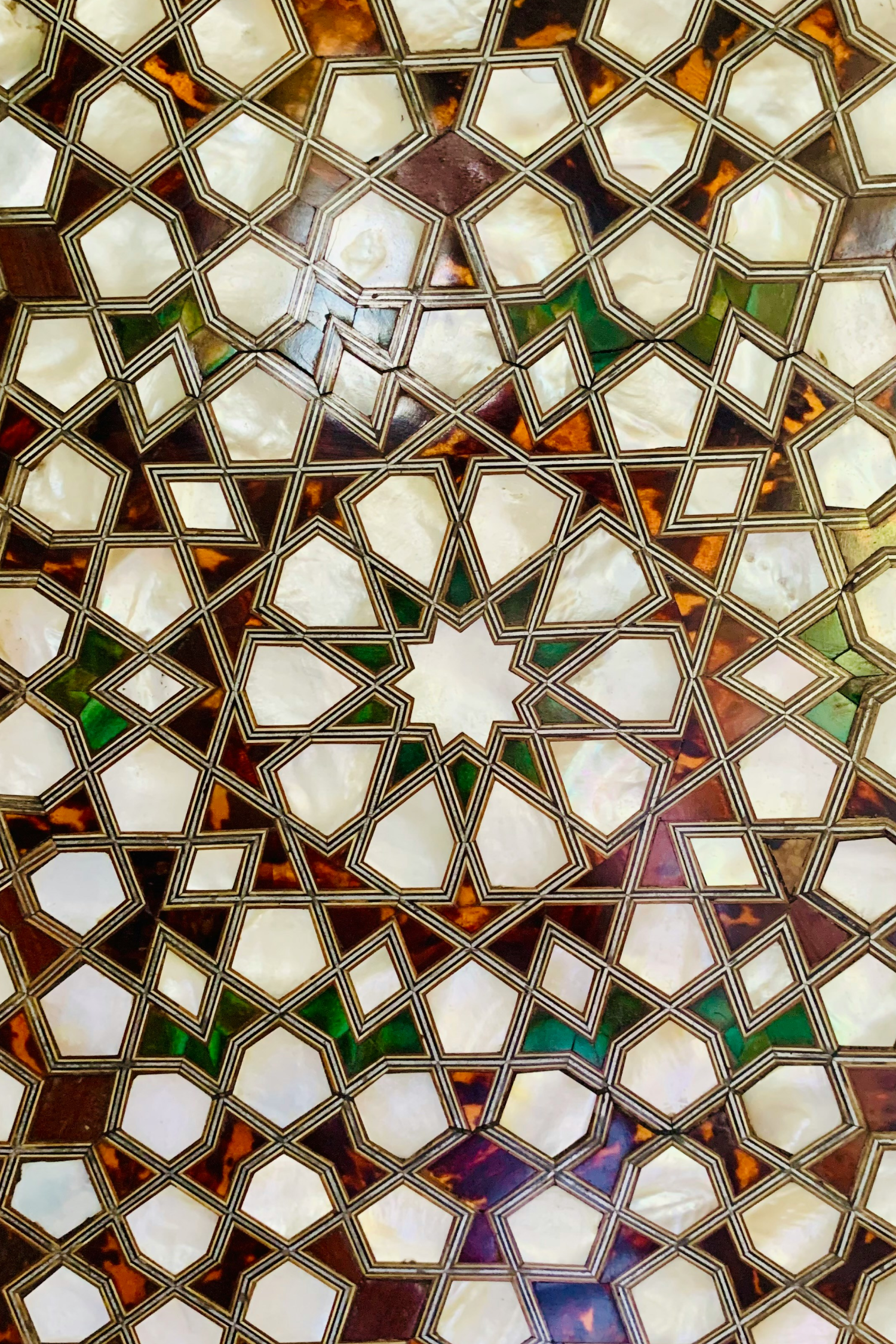
On aesthetic mathematics, the geometry hiding in a 15th century shrine wall, and what opens up when artists and scientists start asking the same questions.
Photo by Adarsh Chauhan on UnsplashJoin upcoming events.
〰️
Dream new patterns with kindred spirits!
Join upcoming events. 〰️ Dream new patterns with kindred spirits!
Earlier this year I emailed a theoretical physicist at Princeton. I wasn't sure exactly what I was looking for — somewhere between genuine curiosity and a hunch that the questions driving my practice as an artist weren't so far from the questions deep science explores. It turns out they aren't. Dr. Paul J. Steinhardt has spent decades researching quasicrystals and the mathematical intelligence embedded in medieval Islamic geometric ornament — territory that overlaps. We talked for an hour. What follows are the ideas from that conversation I'm still thinking about.
Key Threads
Key questions this article explores:
What is aesthetic mathematics, and what does it have to do with making things by hand?
How does the history of quasicrystals reframe the relationship between scientific discovery and craft knowledge?
What opens up when artists and scientists approach the same territory from different directions?
How Long Is the Coast of Britain
In the early 1950s a British mathematician named Lewis Fry Richardson sat down to measure the coastline of Britain and discovered something unsettling. The answer kept changing depending on the length of the ruler. Use a long ruler, skip the small inlets, get one number. Use a shorter ruler, catch more detail, get a bigger number. Use a shorter one still. The coastline, in principle, gets longer the more precisely you measure it. It has no fixed length.
This problem sat unresolved for twenty years until Benoit Mandelbrot picked it up at IBM, fed it into a computer, and realized Richardson had stumbled onto a fundamental property of nature. The natural world is not made of smooth Euclidean shapes — spheres, cylinders, straight lines. It is made of roughness that repeats at every scale. Zoom into a coastline and it looks like a coastline.
Zoom into a cloud and it looks like a cloud. Zoom into a fern and it looks like a fern. Mandelbrot called this self-similarity and coined the word fractal in 1975 — from the Latin fractus, broken.
What he said next tends to get left out of the story. Mandelbrot pointed directly at Islamic geometric ornament and Indian mandalas and noted that these forms had embodied fractal self-similarity for centuries. The man who named fractals pointed back at makers. The structures his computers were generating for the first time had been living in ornamental traditions long before he had language for them.
Rome, 12th Century
The Cosmati were a family of Roman marble workers — more precisely a dynasty, four generations of them — who decorated the floors of medieval churches across central Italy from roughly 1100 to 1300. Their technique, Cosmatesque work, involved cutting stone and colored glass into geometric shapes and setting them into elaborate mosaics. The floors of Santa Maria Maggiore, the Sistine Chapel, Westminster Abbey — all Cosmatesque. What nobody noticed until recently is what those floors actually contain.
Researchers analyzing Cosmati pavements found explicit iterations of what we now call Sierpinski triangles — a fractal structure in which a triangle is subdivided into smaller triangles, those into smaller ones still, at least three levels deep, with the same self-similar logic governing every scale.
The Polish mathematician Waclaw Sierpinski described this structure formally in 1915. The Cosmati had been building it into church floors since the 12th century.
They didn't call it a fractal. They didn't have that word. What they had was a toolkit of shapes, a compositional logic passed through a family across four generations, and an eye for the kind of harmony that emerges when the same structure governs multiple scales simultaneously. The knowledge lived in the practice. The mathematics came seven hundred years later.
“My work has always tried to unite the truth with the beautiful, but when I had to choose one or the other, I usually chose the beautiful.”
What Was Already In The Wall
In 2007 Steinhardt and his collaborator Peter Lu published research in Science demonstrating that medieval Islamic artisans had produced quasicrystalline geometric patterns at the Darb-i Imam shrine in Isfahan in 1453 — more than five centuries before Western mathematics had language for them. They were working from a set of five tile shapes: a decagon, pentagon, hexagon, bowtie, and rhombus. The knowledge lived in the toolkit, passed through generations of makers.
Steinhardt drew a distinction that I keep returning to. Those artisans were almost certainly working in close dialogue with mathematicians and scientists of their time.
The culture's prohibition on depicting animals or human figures meant all visual intelligence poured into geometry — and geometric sophistication became a shared project between makers and thinkers.
By contrast, he studied Chinese ornamental traditions and found they explored only a subset of what was geometrically possible — not from lesser skill, but because in that context craft and mathematical inquiry were developing along separate tracks.
The sophistication of what a tradition encodes is partly a function of who it is in conversation with. That observation cuts in both directions. It describes the past and it describes the present.
The Thing Shechtman Saw
In 1982 a materials scientist named Dan Shechtman looked at a rapidly cooled aluminum-manganese alloy under an electron microscope and saw five-fold symmetry in the diffraction pattern — a structure that was clearly ordered but didn't repeat. His research group asked him to leave. Classical crystallography had held for two hundred years that matter was either ordered or disordered. What Shechtman was looking at was neither.
He held his position. In 2011 he won the Nobel Prize in Chemistry.
Steinhardt had been working on the theoretical side of the same problem simultaneously. What they each arrived at from different directions is what we now call a quasicrystal. The Isfahan artisans had built one in 1453. The Cosmati marble workers had been building fractal structures since the 12th century. Shechtman saw it in metal in 1982 and was told he had made an error.
This is the pattern. The structure exists. The proof arrives later. The people who insist the structure is impossible are often sitting closest to the official instruments.
Hermann Weyl And The Ornament Lectures
Steinhardt recommended a book to me during our conversation: Symmetry by Hermann Klaus Hugo Weyl, published in 1952 by Princeton University Press. Weyl (1885–1955) was one of the most important mathematicians of the twentieth century — a key figure in quantum physics and general relativity, a colleague of Einstein at the Institute for Advanced Study in Princeton. He was also, unusually for someone in his field, deeply shaped by philosophy and aesthetics. His wife Helene had been a student of Edmund Husserl, the philosopher who founded phenomenology — the tradition that insists we must begin with direct experience before we theorize. Through that relationship, intuition was never separate from Weyl's mathematics.
Symmetry was his final book, what he called his swan song. He retired from Princeton in 1951 and chose as his last gesture not a technical paper but a lecture series accessible to anyone — a survey of symmetry in sculpture, painting, architecture, ornament, nature, and physics, treating all of these with equal seriousness. The book moves through bilateral symmetry in the body, the 17 possible plane symmetry patterns, crystals, and spacetime — never ranking one domain above another. Symmetry is now on my reading list this season.
The Seventeen And The One
There are exactly 17 possible symmetry patterns for a two-dimensional plane. Seventeen. Every wallpaper, every textile border, every tiled floor, every illuminated manuscript margin belongs to one of these groups — whether or not the maker knew the formal classification. This was formalized as group theory in the 19th century. The traditions that fully explored all 17 did so centuries earlier, through practice.
Then in 2023 something happened that made mathematics news outside of mathematics. David Smith — a retired typographer and self-described shape hobbyist in Yorkshire — discovered what geometers had been searching for since the 1960s: a single tile shape that fills infinite space without ever repeating. Not two shapes, like Penrose needed. One. It became known as the Hat tile, or the einstein — from the German ein Stein, one stone. Nothing to do with Albert.
The Hat refuses periodicity structurally. You cannot make a repeating pattern with it no matter how you try. The same team followed it two months later with the Spectre — a close relative that tiles aperiodically without even needing its mirror image.
Craig Kaplan, the computer scientist who helped prove the Hat's aperiodicity, is the same person who built Taprats — the open source Islamic pattern generator. He sits at the intersection of mathematics, computation, and ornament, and the Hat tile came to him through an email from an amateur. That detail matters. The discovery happened in the community of people who simply love pattern, not in a funded research program.
Aesthetic Mathematics
The thread running through all of this is what gets called aesthetic mathematics — the observation, made seriously by working mathematicians, that beautiful solutions tend to be correct ones. That the feeling of harmony often precedes the proof. That intuition leads toward truth in mathematics the same way it leads toward form in making.
Weyl lived this. So did Escher, who arrived at mathematical structures through drawing that professional mathematicians were simultaneously formalizing through theorem — and who corresponded with them as an equal, each side finding in the other something their own discipline couldn't produce alone.
This is not a soft argument. It is a methodological one. The mathematician follows elegance toward truth. The maker follows structure toward form. The routes are different. The territory overlaps in ways that are still being mapped.
Sources:
Symmetry — Hermann Weyl (Princeton Science Library, 1952)
The Second Kind of Impossible — Paul J. Steinhardt
The Fractal Geometry of Nature — Benoit Mandelbrot (1982)
Lu & Steinhardt, "Decagonal and Quasi-Crystalline Tilings in Medieval Islamic Architecture," Science, 2007
Frezza et al., "Sierpinski Triangles in Stone, on Medieval Floors in Rome," Aplimat, 2014
Smith, Myers, Kaplan & Goodman-Strauss, "An Aperiodic Monotile," 2023
Woven Wisdom
Truth worth holding onto:
The institution is the archive What gets preserved is what institutions decide to carry. Cloister schools, convent workshops, and book-exchange networks kept women's ornamental knowledge alive for centuries. The absence of names in the ledgers is a fact about the ledgers.
The border held what the center couldn't Grotesque ornament in the margin was the space where visual imagination was most free. Women worked it most. It was labeled decorative. That label was doing a job.
Transmission needs structure One person can carry knowledge for a lifetime. An institution can carry it across generations. Where women's ornamental institutions dissolved, the knowledge thinned. Where they held, it traveled.
Recovery is its own form of making The Eibingen nuns copying the Scivias in the 1920s–30s. The scholars drawing the Hortus before Strasbourg burned. Loretta Vandi writing the first Burlamacchi monograph in 2025. All of it is making.
Practice Toolkit
Map your symmetry group Take something you've made and figure out which of the 17 plane symmetry groups it belongs to. Simple visual guides exist online. Notice whether your instinctive choices cluster around particular symmetry types — and what it would feel like to work deliberately in an unfamiliar one. The 17 are not a constraint. They are the complete palette.
Look for the scale Fractals are structures that look the same at different scales of magnification. Spend one session looking at a piece of ornament — a carpet page, a textile border, a mosaic fragment — and ask: does the logic that governs the whole also govern the part? Where does the self-similarity begin and end? What happens at the edge?
Read one page of Weyl Start with lecture three in Symmetry, on ornamental symmetry. Sit with something you've made in front of you while you read it. Let the vocabulary land on the object.
As I've been sitting with these examples — the Cosmati floors, the Isfahan shrine, Shechtman's microscope, a mailing list in Yorkshire — I keep returning to something that feels less like a historical observation and more like a live question. The mathematical structures that makers encoded across centuries weren't accidents or approximations. They were arrived at through sustained, serious attention to form — through toolkits refined across generations, through the kind of cross-disciplinary proximity that lets a craft tradition push past replication into genuine discovery.
What that means for practice now is still opening up for me. Every ornamental tradition that hasn't yet been looked at with the right instruments is a possible Isfahan. Every toolkit passed hand to hand carries more than technique — it carries a logic, a set of relationships between shapes, a way of resolving form that may be encoding something nobody has formally named yet. What becomes possible when more displines start working together?
Events
Ready to dive deeper? Join our community of master artisans, cultural stewards, and creative practitioners exploring the intersection of traditional craft and contemporary life. Classes, intensives, and ceremonial gatherings across LA and online for artists, designers, crafters, illustrators, and makers of all backgrounds and levels. Our programs unite ancient wisdom with contemporary practice, cultivating living heritage through embodied craft, storytelling through making, communion with nature, cultural preservation, meditative practice, and the celebration of life's luminous beauty.




#aestheticmathematics #quasicrystals #islamicgeometry #fractals #cosmatesque #patternmaking #symmetry #hattile #hermannweyl #mandelbrot #mcescher #craftandscience #ornament #folklounge #patternkeepers #geometricart #embroidery #mathematicsandart #tilingtheory #sierpinski