The Women Who Held The Gold
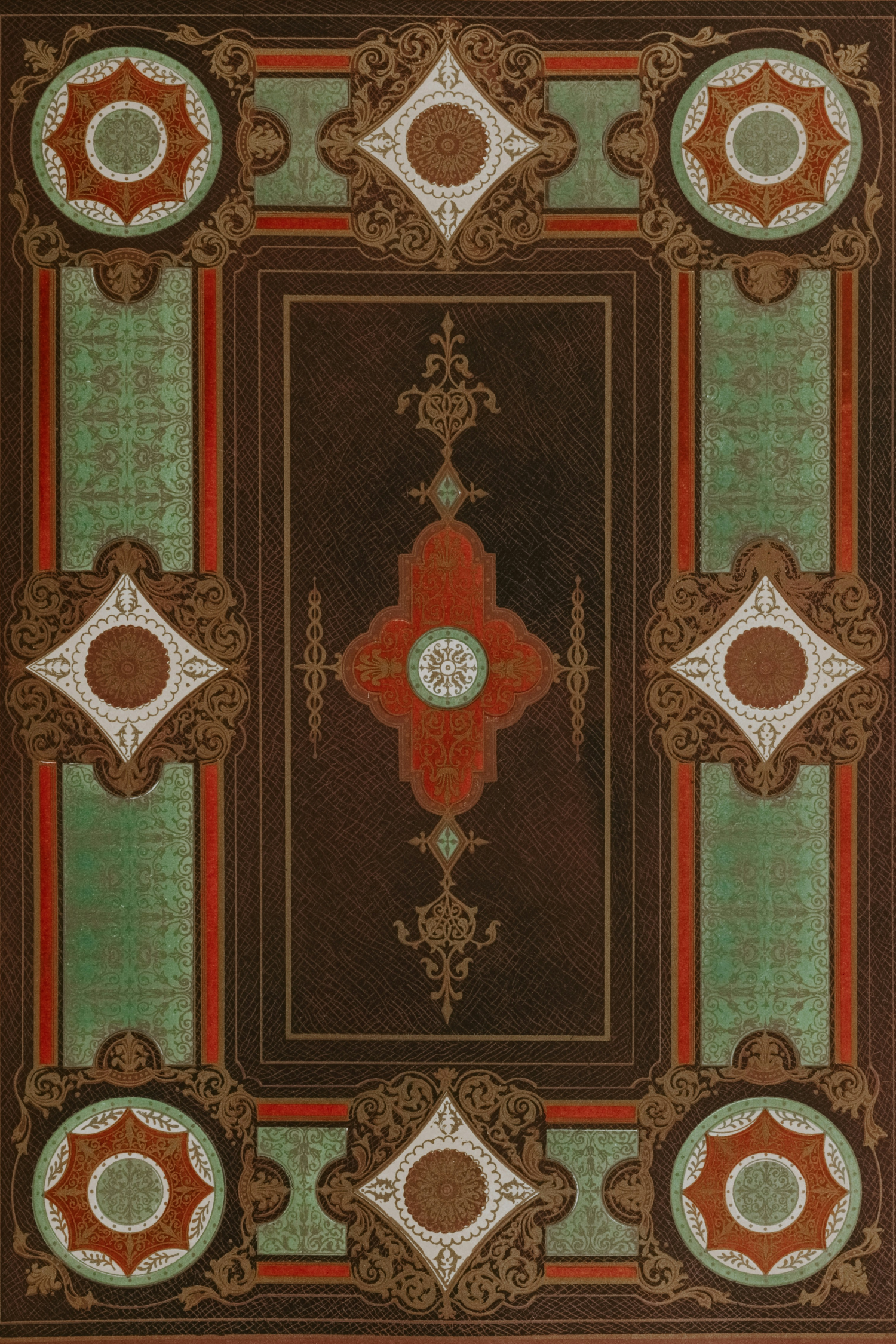
On the convent as design studio, the border as a licensed zone of knowledge, and what ornamental manuscripts reveal about who gets counted as a maker.
Photo by The New York Public Library on Unsplash
Join upcoming events.
〰️
Dream new patterns with kindred spirits!
Join upcoming events. 〰️ Dream new patterns with kindred spirits!
I've been thinking about who gets to be called a maker — and who doesn't — ever since I started researching ornament for the Pattern Keepers grant from the City of Pasadena and spending time with digitized manuscripts at the Huntington Library. Being Armenian, illuminated manuscripts have always felt personal to me; when I started wondering whether there were women behind them, I wasn't prepared for how many there were. Just last year, in March 2025, the Getty Museum acquired Christine de Pizan's Book of the City of Ladies — the first female-authored work ever to enter their manuscript collection.
Key Threads
Key questions this article explores:
Did women run real design institutions — with students, workshops, and their own styles — even when no one wrote their names down?
Why did the decorative border become the one space where women had the most creative freedom?
Who gets called a knowledge-keeper, and does that still matter today?
When someone recovers lost work and keeps it alive, is that also a form of making?
What Is An Illuminated Manuscript?
Illuminated Manuscript
A handwritten book decorated with images, gold leaf, and ornamental borders — made mostly between the 5th and 15th centuries. 'Illuminated' refers to how gold and silver leaf literally catches the light. These books were sacred objects as much as texts — psalters, prayer books, music books, gospels. Their decoration wasn't just pretty: it was theological argument in visual form. The people who painted them were called illuminators.
Illuminator
The artist who painted the images, borders, and ornamental decoration in a manuscript — different from the scribe, who copied the text. Illuminators were paid less, credited less, and their work was called decoration rather than intellectual labor.
Women did a large and well-documented share of this work across medieval Europe. Almost none of them appear by name in the payment records.
For Pattern Keepers, what matters is that the ornamental borders of these books weren't filler. They carried a visual grammar of cosmology, natural observation, and sacred symbol that the text alone couldn't hold. The people building that grammar, far more often than history recorded, were women.
Sources:
Christine de Pizan, Book of the City of Ladies (1405)
Christine Sciacca, Illuminating Women in the Medieval World (Getty Publications, 2017)
The Convent As Design Studio
Cloister School
An educational institution inside a convent or monastery (schola claustri) that trained novices in reading, writing, music, theology, and the arts — including the ornamental arts. Among the only places in medieval Europe where women received a sustained formal education. Knowledge moved hand to hand, teacher to student, generation to generation.
Sibylla von Bondorf, Upper Rhine, ca. 1450–1524
Other artists pasted her miniatures into their own manuscripts and openly copied her style — her work was that good and that distinctive. What scholars now call the regional 'cloister style' of the Upper Rhine traces back to her. She never appears in any guild record. Her influence traveled through the book-exchange networks between religious houses — by routes the official ledger wasn't watching.
Hildegard of Bingen's Scivias (ca. 1151) contains 35 full-page illuminations that are genuinely otherworldly — a human figure inside a dark sphere ringed by fire, interlocking wheels representing the Trinity, circular cosmic maps that Carl Jung later studied in his own work on the unconscious. Whether Hildegard painted them herself or directed their making is still debated. The visual program was hers either way. The original manuscript survived 800 years before disappearing in WWII. What we have now is a facsimile made in the 1920s and 30s by nuns at Eibingen — women copying the work of a woman across eight centuries.
Herrad of Landsberg described herself as 'a little bee inspired by God' gathering nectar from many flowers for her community. Her Hortus Deliciarum — 'Garden of Delights,' finished 1185 — was 648 pages and 336 illustrations: an entire medieval world assembled as a teaching tool for the women in her cloister school. Philosophy. Music. The cosmic battle between Virtue and Vice. Her own face in the illustration of the abbess presenting the book. It burned in 1870 when Strasbourg was shelled. What survives is a partial reconstruction from notes made before the fire.
The convent gave these women something that secular workshops rarely offered: an institution that took their making seriously, resources to sustain it, and a community that would carry it forward.
I think about this a lot — what actually makes sustained creative practice possible over time? The cloister school isn't something we can copy, but it shows something real: craft knowledge passed through relationship, inside a structure that treats transmission as part of its purpose, survives.
Sources:
“The feather flew, not because of anything in itself, but because the air bore it along. Thus am I — a feather on the breath of God.”
The Border As Permission Slip
Grotesque
A fantastical figure in the margin or border of a manuscript — hybrid creatures, masks, dragons, serpents, columns that sprout limbs, humans dissolving into vines. The word comes from grotta (cave): ancient Roman underground rooms decorated with this kind of wild biological mixing were rediscovered in the late 1400s, and the imagery spread fast into European ornamental practice. In manuscripts, grotesques lived in the spaces outside the sacred text, where the rules were looser and the imagination had more room.
Medieval manuscripts were made by two different people: the scribe, who copied the text, and the illuminator, who painted everything else. The scribe got named and paid more. The illuminator — who made the borders, grotesques, gilded initials, all the visual work — got named rarely and paid less. Women did a large share of the illumination work. The records almost never show it.
Eufrasia Burlamacchi, San Domenico, Lucca, 1482–1548
Dominican nun and the main illuminator at her convent's scriptorium. She ran the workshop, trained the next generation, and made five antiphonaries — books of sacred choral music — that survive today at Dominican University in San Rafael, California. Her illuminations are spiritually serious and restrained. But her borders are doing something else entirely: masks, dragons, cornucopias, serpents in symmetrical patterns, columns that gradually grow limbs. Loretta Vandi's 2025 monograph (the first book ever written about Burlamacchi) argues she was choosing very deliberately what to let into the border and what to keep out. The borders were where she thought.
The grotesque border was the one space in a sacred book where visual imagination was licensed to go further than the text allowed — where cosmological ideas, natural-world imagery, and visual play could live alongside the official content. Women worked this space more than any other part of the page, and it was consistently labeled as ornament, meaning it didn't count as real intellectual work.
Jeanne de Montbaston ran a professional book workshop in Paris with her husband in the early fourteenth century. After he died, she went to the University of Paris for independent licensing and got it. She's one of the only secular women illuminators we have by name — which says more about how the records were kept than about how many women were actually working.
The same logic that called border work decoration also calls embroidery and textile art supplementary. When a medium gets labeled minor, the knowledge inside it stops being counted as knowledge.
Sources:
Christine De Pizan And The City Made Of Evidence
Christine de Pizan read a text by a male author that claimed to honor women while cataloguing everything wrong with them — and felt, as she writes at the opening of her own book, a wave of self-doubt. Maybe all these learned men were right. Then three allegorical figures appeared in her study: Reason, Rectitude, and Justice. They told her to build a city.
She spent three years going through history and pulling out every woman who had been skilled, wise, or significant and whom the literature had passed over or misrepresented. Scholars, inventors, warriors, rulers, artists, saints. The Book of the City of Ladies, finished in 1405, is the result. Each woman's story is a stone in the wall. The city was always the argument.
Christine didn't paint the Getty's copy — the 108 miniatures were added by a Parisian workshop decades after she died. But during her lifetime she supervised the visual programs of manuscripts she commissioned and directed illuminators on how to show her and her ideas.
She cared deeply about how the work looked, because she understood that how a story is presented shapes whether it's taken seriously.
The Book of the City of Ladies is 600 pages of assembled evidence that women have always been building things. Christine de Pizan just wrote it down.
The Getty manuscript is Ms. 129 in their collection, in Brentwood right now. The 1405 manuscript is freely readable at the Library of Congress. For a book that was out of print and out of conversation for centuries, it's having a remarkable moment.
Sources:
Andaleeb Badiee Banta et al., Making Her Mark: A History of Women Artists in Europe, 1400–1800 (Goose Lane, 2023)
What The Archive Missed
Herrad's encyclopedia. Hildegard's cosmic mandalas. Sibylla von Bondorf's school without a name. Eufrasia Burlamacchi's thinking-space borders. Jeanne de Montbaston navigating a licensing system that wasn't built for her. Christine de Pizan building a city out of recovered lives. Each of them was doing serious, sustained, institutionally grounded work. The official record filed it somewhere else.
The margin was a classification, not a location. These women were working at the center of their field. The label 'decorative' was applied after the fact.
The Scivias is on Internet Archive. The Hortus Deliciarum is on Internet Archive. The Book of the City of Ladies is at the Library of Congress. The knowledge these women built and passed forward is more accessible right now than it has ever been. The question Christine was asking in 1405 is easy to take up today.
Sources:
Woven Wisdom
Truth worth holding onto:
The institution is the archive What gets preserved is what institutions decide to carry. Cloister schools, convent workshops, and book-exchange networks kept women's ornamental knowledge alive for centuries. The absence of names in the ledgers is a fact about the ledgers.
The border held what the center couldn't Grotesque ornament in the margin was the space where visual imagination was most free. Women worked it most. It was labeled decorative. That label was doing a job.
Transmission needs structure One person can carry knowledge for a lifetime. An institution can carry it across generations. Where women's ornamental institutions dissolved, the knowledge thinned. Where they held, it traveled.
Recovery is its own form of making The Eibingen nuns copying the Scivias in the 1920s–30s. The scholars drawing the Hortus before Strasbourg burned. Loretta Vandi writing the first Burlamacchi monograph in 2025. All of it is making.
Practice Toolkit
Border Mapping What are you treating as secondary in your current practice? Spend one session working only those elements as the main subject. What's been living there that you haven't fully named?
Transmission Tracing Pick one technique or material and trace it backward: who taught you, who taught them, what held that knowledge? Notice where the chain breaks. Notice whether those people have names anywhere in the record.
Archive Sitting Open the Book of the City of Ladies at the Library of Congress or the Scivias on Internet Archive. Find one page. Stay with the ornamental program — borders, initials, grotesques — and ask what's being said there that the text doesn't say.
As I've been sitting with these women's stories, I keep coming back to something that feels familiar from ornamental traditions themselves: the understanding that pattern is never just decoration, that what gets passed hand to hand across generations carries more than technique, and that the most significant transmissions often happen in the spaces the official record wasn't watching.
Every project becomes an opportunity to ask the questions these women were already living: Whose making gets counted, and whose gets filed under decoration? What are we transmitting, and to whom? What would change if we understood craft knowledge as something that belongs to a lineage rather than an individual — something we received, are responsible for, and will pass forward? Through careful attention to pattern and transmission, we participate in the ongoing work of keeping the knowledge alive.
Events
Ready to dive deeper? Join our community of master artisans, cultural stewards, and creative practitioners exploring the intersection of traditional craft and contemporary life. Classes, intensives, and ceremonial gatherings across LA and online for artists, designers, crafters, illustrators, and makers of all backgrounds and levels. Our programs unite ancient wisdom with contemporary practice, cultivating living heritage through embodied craft, storytelling through making, communion with nature, cultural preservation, meditative practice, and the celebration of life's luminous beauty.




#womenilluminators #medievalart #manuscriptillumination #cloisterschool #grotesque #patternkeepers #christinedepizan #hildegardofbingen #herradoflandsberg #eufrasiaburlamacchi #folklounge #embroidery #culturaltransmission #feminismart #illuminatedmanuscripts #sacredgeometry #womenartists #gettylibrary #textileheritage #armenianheritage