9 Embroidery Giants Before Instagram
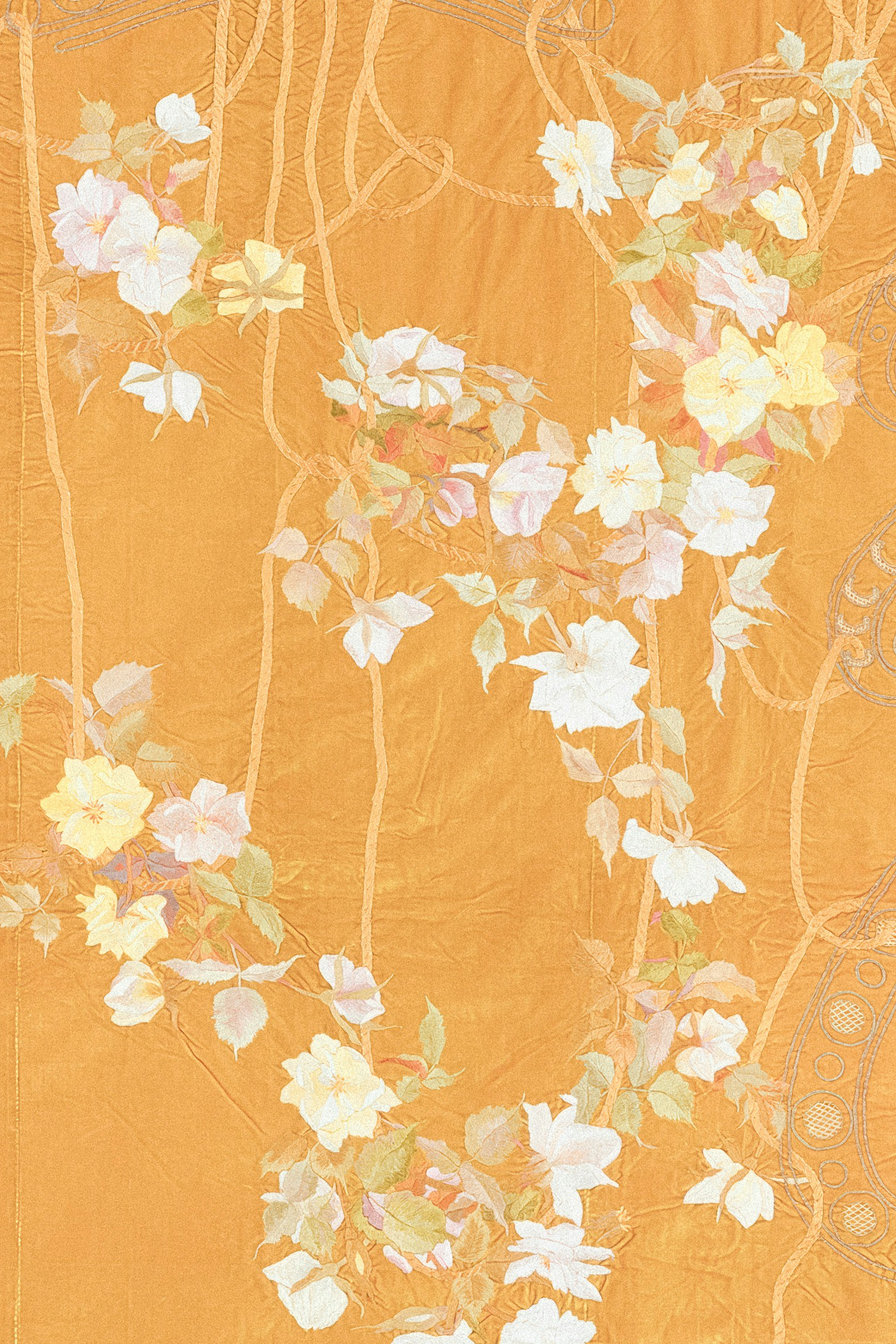
Some of the most important embroidery books ever written are free to read right now, in your browser. They exist in the Internet Archive's public domain collection — digitized, searchable, available to anyone. Most people don't know they're there.
Photo by Art Institute of Chicago on Unsplash
Join upcoming events.
〰️
Dream new patterns with kindred spirits!
Join upcoming events. 〰️ Dream new patterns with kindred spirits!
I spent two years drifting through libraries before I understood what I was looking for. Somewhere in 2023 I started exploring foundational books on ornament and textile arts. By 2025 I was visiting different museums and online archives, learning to navigate databases and search results. Each time I find something magical, I feel so lucky to live today. Last few months I felt that way when I was researching tile and came across incredible sales catalogs that document the history and designs of SoCal tile heritage. Today, I thought it be fun to explore the highly viewed gems of the Internet Archive.
Key Threads
Key questions this article explores:
Which books genuinely shaped embroidery as a discipline — and what makes them different from the rest?
Who were the women and scholars behind these texts, and what was at stake in writing them?
How does historical reference serve makers working across cultural traditions today?
What does it mean that this knowledge has been sitting in public domain, freely available, largely undiscovered?
Two Books That Set The Terms
The Dictionary of Needlework by S.F.A. Caulfeild and Blanche Saward, published in 1882, set the terms for what embroidery knowledge was supposed to look like. Over 1,200 wood engravings, encyclopedic coverage of stitches, materials, technical terms, and technique histories including church embroidery, lace, and ornamental needlework. Textile historians still cite it today as a primary reference. Nothing produced before or since has matched its scope.
🧶 The Dictionary of Needlework — S.F.A. Caulfeild & Blanche Saward · 1882
Its continental counterpart is the Encyclopedia of Needlework by Thérèse de Dillmont, published in 1890. De Dillmont was an Alsatian needlework authority whose book became the most widely translated needlework text in history. DMC published and distributed it globally, inadvertently creating the broadest public access to serious needlework instruction the 19th century ever produced. Between the two of them, Caulfeild and de Dillmont defined the infrastructure of the field. If you were building a library from nothing, you would start here.
Grace Does Not Play Small
Christie — known in her time as Mrs. Archibald Christie — studied painting at the Slade School of Fine Art before turning to embroidery at the Central School of Arts and Crafts, where her work was praised in a student exhibition review in 1900. The following year she was appointed instructor in embroidery and tapestry weaving at the Royal College of Art, brought in by William Lethaby — founder of the Central School and one of the most influential figures in the Arts and Crafts movement. She held that position until 1921. Her stunning samples are held at the V&A, where they were accessioned as objects of significance in their own right.
Her first major publication came in 1906: Embroidery and Tapestry Weaving, part of Lethaby's Artistic Crafts Series of Technical Handbooks. It covered technique with rigor and precision, establishing her as a serious practitioner-writer at the start of her career. Three years later, following A.F. Kendrick's landmark 1905 V&A exhibition on English embroidery — which Kendrick himself said profoundly influenced her research — Christie edited and contributed to a short-lived serial publication simply titled Embroidery. It ran six issues between 1908 and 1909, published by James Pearsall.
Samplers and Stitches, published in 1920, was the culmination of all of it. It integrated design theory with stitch instruction in a way that codified how embroidery functioned as a compositional and design discipline. The two books and the serial together chart the full arc of Christie's contribution — from technical instruction to editorial platform to theoretical framework. The Internet Archive is one of the few places her work remains genuinely accessible.
🧶 Embroidery and Tapestry Weaving — Grace Christie
🧶 Embroidery: A Collection of Articles — Grace Christie · 1909
“The needlewoman should be absolute master of her needle, for there is a great charm in beautifully carried out stitching; also a good design can be made mechanical and uninteresting by a wrong method of execution.”
From Design Argument To Historical Record
Lewis F. Day was a leading theorist of the Arts and Crafts movement, and Art in Needlework, published in 1900, repositioned embroidery within the broader discourse of design — as a discipline with its own aesthetic logic and cultural weight. He positioned the needle as a design instrument at a moment when the applied arts were actively fighting for cultural legitimacy, and that framing shaped art school curricula for decades. For those of us working at the intersection of ornament and cultural transmission, the argument feels as alive today as it did then.
A Book of Old Embroidery by Holme and Kendrick — Kendrick was Keeper of Textiles at the V&A — followed that groundwork with art historical substance. It was among the first serious attempts to treat embroidery as a subject of art historical inquiry on its own terms, establishing that the field had a visual culture worth documenting and a critical tradition worth building.
The Early Modern Embroidery and Lace Pattern Books index by Helen Hough extends that project further: a gateway to over 250 Renaissance pattern books published between 1500 and 1700, with bibliographic and access information for each. Treat it as a map into a territory most people don't know exists.
🧶 Art in Needlework — Lewis F. Day · 1900
🧶 A Book of Old Embroidery — Holme & Kendrick · 1921
🧶 Early Modern Embroidery and Lace Pattern Books: Index — Helen Hough
Who Gets A Pattern Book
The pattern books that survived into the historical record are the ones whose publishers had money and distribution networks — Vinciolo in Venice, Schönsperger in Augsburg, printing houses in Lyon and Antwerp that saw a commercial market in ornament and built the first real infrastructure for transmitting decorative knowledge across Europe.
What that system chose to carry is one question. What it left behind is more interesting. Access required literacy, proximity to urban print culture, and enough money to buy a book. Embroiderers working outside those conditions — and there were many, across many traditions — passed knowledge differently: through objects, through demonstration, through watching someone work. The infrastructure had a center, and most of the world was not in it.
The Hough index of 250+ Renaissance pattern books is almost entirely Western European. That shape tells you something — about who had presses, who was considered a legitimate source of ornamental knowledge, and whose patterns traveled as folklore rather than published design. Some of what fell through is recoverable, in objects and collections and the memory of makers. Some of it isn't. The archive has an edge, and a lot of the world was on the other side of it.
Woven Wisdom
Truth worth holding onto:
The most important needlework texts ever written are free and open to anyone. The Internet Archive makes that possible regardless of budget or institution. That kind of access changes what research looks like.
Traditions don't vanish. They scatter — into objects, into archives, into the hands of people still practicing quietly somewhere. What feels lost is often just waiting to be found.
Finding something unexpected in an archive rarely feels like research. It feels like reunion — like the craft was always trying to get back to you.
Practice Toolkit
Browse before you read. Grace Christie's actual worked samples are in the V&A collection online — the physical objects behind the books. Seeing what she stitched changes how you read what she wrote.
Pick a decade, follow one book. Open the Hough index and choose a decade — 1540s, 1580s, 1620s. Find one pattern book from that period and follow it into the archive. The index is a portal, not a reading list. Every entry leads somewhere unexpected.
Look up a stitch you think you already know. Open Caulfeild or de Dillmont and find it. Both books carry techniques hiding inside familiar names, regional variations that never made it into modern instruction, tools that haven't existed for a century. You will not find what you expect to find.
The books that defined embroidery for the last century were written between 1882 and 1920. The question for our generation is what we are documenting right now — the diasporic practices, the oral traditions, the community knowledge that still has no definitive text. Someone will write those books. The archive is waiting.
Events
Ready to dive deeper? Join our community of master artisans, cultural stewards, and creative practitioners exploring the intersection of traditional craft and contemporary life. Classes, intensives, and ceremonial gatherings across LA and online for artists, designers, crafters, illustrators, and makers of all backgrounds and levels. Our programs unite ancient wisdom with contemporary practice, cultivating living heritage through embodied craft, storytelling through making, communion with nature, cultural preservation, meditative practice, and the celebration of life's luminous beauty.




#embroiderygiants #internetarchive #embroideryhistory #needlework #fiberarts #folklounge #embroiderybooks #publicdomain #gracechristie #lewisfday #dillmont #caulfeild #samplers #embroideryresources #textilehistory #patternkeepers #crafthistory #embroideryeducation #needleworkhistory #materialtraditions